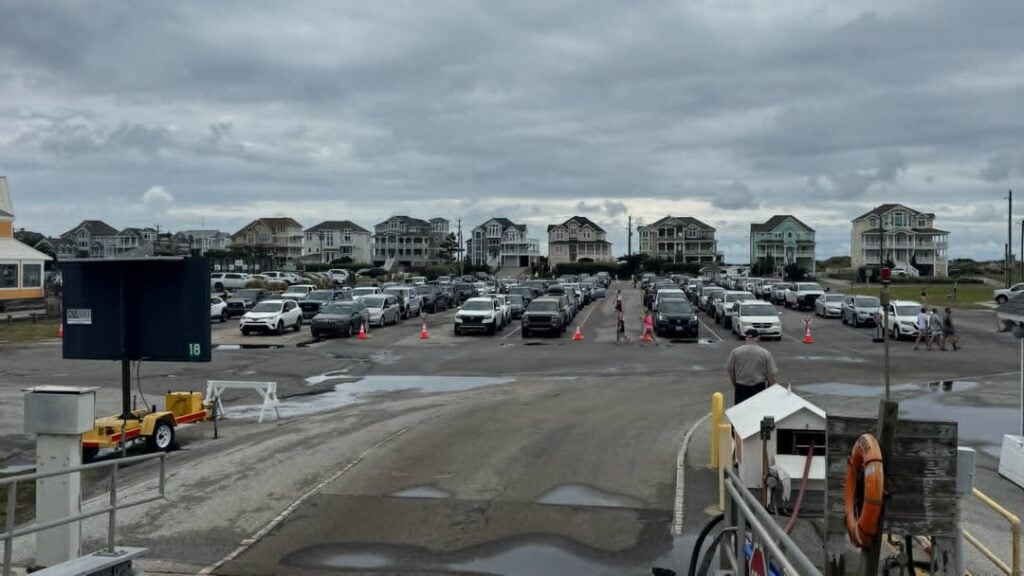
Ocracoke residents, business owners, and community leaders gathered Tuesday evening at the Ocracoke Community Center with an immediate goal: persuading the North Carolina General Assembly to postpone the implementation of newly mandated ferry tolls by one year, arguing that the Jan. 1, 2027 deadline established in the recently adopted state budget is unworkable.
The meeting, hosted by the Ocracoke Civic & Business Association, identified delaying implementation until Jan. 1, 2028, as the community’s immediate legislative priority.
Supporters said an additional year would give the N.C. Department of Transportation’s Ferry Division and the N.C. Board of Transportation more time to establish toll rates, develop a collection system, consider public input and resolve numerous unanswered questions.
The meeting came two weeks after Gov. Josh Stein signed Senate Bill 257, the 2026 Appropriations Act, into law on July 7. The law requires the Ferry Division to begin collecting tolls on every state ferry route no later than Jan. 1, 2027.
If implemented as written, the legislation would end nearly 70 years of free vehicle ferry service on the Hatteras-Ocracoke route. The vehicle ferry remains free and does not accept reservations, although the separate seasonal Ocracoke Express passenger ferry already charges a fare.

What the new law requires
The budget makes sweeping changes to state ferry funding and toll policy.
Under the legislation, the N.C. Board of Transportation, in consultation with the Ferry Division, must establish tolls for every state ferry route. The law also creates a $150 annual commuter pass available to permanent residents of North Carolina’s coastal counties and active-duty military personnel, while exempting school buses and other student transportation vehicles from paying tolls.
Revenue collected from ferry tolls will be deposited into a newly created Ferry Capital Special Fund dedicated to replacing passenger vessels throughout the statewide ferry system. The law also authorizes the Ferry Division to use existing operations funding to purchase and install whatever tolling technology and infrastructure is necessary to comply with the mandate.
One of the meeting’s central concerns was that the budget requires toll revenue to fund vessel replacement projects but does not provide additional money to establish the toll collection system itself.
Justin LeBlanc, executive director of the Ocracoke Access Alliance (OAA), told attendees that implementing the system would likely require millions of dollars before the first toll is ever collected.
“January 1, 2027 is impossible. This is fundamentally impossible,” LeBlanc said, calling the implementation deadline “probably the biggest red flag of all.”
LeBlanc explained that while the legislation directs the Board of Transportation to establish toll rates, the board would first have to complete a formal public process before adopting those rates.
“The Board of Transportation would go through a process to give a public comment period,” he said, noting that completing those procedural requirements before January would be extremely difficult.

Questions remain unanswered
Much of the hour-long discussion centered on practical questions that attendees said remain unresolved, and which are not addressed in the state’s recently passed budget.
Among them:
- How tolls would actually be collected on routes that have never had toll booths.
- Whether an electronic system, reservation-based payment system, or another method would be used.
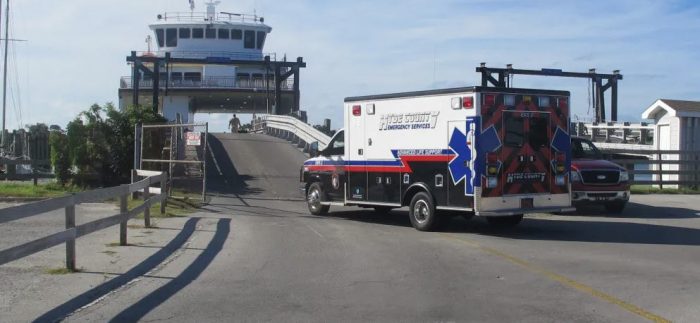
- Whether emergency vehicles, ambulances, county vehicles, and other public-service vehicles would receive exemptions.
- Whether Ocracoke residents or nonresident property owners could eventually receive additional discounts beyond the commuter pass.
- How implementation costs would be funded.
- Whether the Board of Transportation has flexibility to establish different rates for different classes of users.
LeBlanc noted that the legislation specifically exempts school buses but does not extend the same protection to ambulances, law enforcement vehicles, or other public vehicles.
“We think more than just school buses should be exempt,” he said. “Certainly, ambulances and other official services.”
He also pointed out that the new $150 commuter pass is separate from the Ferry Division’s existing Priority Pass system, something he said has caused confusion among residents. The Priority Pass allows eligible residents and essential-service vehicles to receive priority boarding ahead of general traffic.
“Nothing in the state budget… adjusts the Priority Pass in any way,” LeBlanc said. “The $150 annual commuter pass does not get you a Priority Pass.”

Delaying implementation, not abandoning tolls
Although Ocracoke leaders have previously proposed alternative toll structures, Tuesday’s meeting focused almost exclusively on extending the implementation deadline.
“Our focus is exclusively on extending the implementation,” LeBlanc said.
He said delaying the deadline would accomplish two things.
First, it would provide enough time for the Ferry Division and Board of Transportation to establish a workable system.
Second, it would give lawmakers time to revisit other provisions of the law, including exemptions and commuter protections.
“If we can extend it out a year at least, that gives us time to fix some of the other issues,” he said.
Several attendees also questioned whether residents, businesses and local governments had been given enough opportunity to provide input before the toll requirement was included in the state budget.
Others expressed concern that implementation costs could consume operational funding needed to actually operate the ferry system.

NCDOT: Discussions are just beginning
The Ferry Division has not announced how toll collection will work or what rates might eventually be proposed.
In a statement provided Tuesday, NCDOT spokesperson Tim Hass said:
“The N.C. Department of Transportation’s Ferry Division will work closely with the N.C. Board of Transportation and stakeholders to execute the state budget requirement that tolls be established on all ferry routes.
“In the coming months, we will begin discussions about the pricing system, method of tolling, and other infrastructure that will be required for this implementation.
“Further details will be provided once they become available. The department remains committed to providing access to our coastal communities.”

Economic concerns for Ocracoke
Meeting participants said tolls could affect more than residents’ personal travel costs.
Ocracoke’s economy depends heavily on visitors arriving through the Hatteras-Ocracoke route, particularly day-trippers traveling south from Hatteras Island.
Businesses could also face higher transportation costs if delivery companies, repair crews, contractors, and other vendors are required to pay tolls each time they travel to the island.
Those additional costs could ultimately be passed along to Ocracoke residents and businesses through higher prices for goods and services.
The Ferry Division is working with the Institute for Transportation Research and Education at N.C. State University on an updated study of the ferry system’s economic effects.
A previous study found that the North Carolina Ferry System supported 5,860 jobs, generated $217.3 million in labor income and contributed $735.2 million in statewide economic output.
The earlier analysis also estimated that the ferry system generated $32.5 million in state and local tax revenue and provided $40.3 million in passenger benefits, including travel-time savings, vehicle-cost savings and safety benefits.
The new study asks riders about spending, trip purposes, wait times, service reliability, ticketing, reservations, and the importance of ferry service to their travel. The study, which invited public participation, can be found here.
Ocracoke Access Alliance call to action
The Ocracoke Access Alliance is encouraging residents, visitors and supporters to contact members of the North Carolina General Assembly and request that lawmakers delay implementation of statewide ferry tolls.
The organization released the following statement Tuesday:
Please contact your elected officials in the North Carolina General Assembly to urge them to delay the implementation of ferry tolls! The budget passed earlier this month requires tolls to be implemented by January 1, 2027. The Ferry Division indicates this is simply not feasible.
Please contact members of the NCGA by phone or email (www.ncleg.gov for contact information). Please request the implementation date be extended until January 1, 2028, or later to give the N.C. Board of Transportation time to consider and set tolls and for the Ferry Division to develop a toll collection system.
Senators of particular importance include:
Sen. Phil Berger
phil.berger@ncleg.gov
919-733-5708
Sen. Vicki Sawyer
vicki.sawyer@ncleg.gov
919-715-3038
Sen. Michael Lazzara
michael.lazzara@ncleg.gov
919-715-3034
Sen. Bill Rabon
bill.rabon@ncleg.gov
919-733-5963
Sen. Norman Sanderson
norman.sanderson@ncleg.gov
919-733-5706
Article credit: Island Free Press.